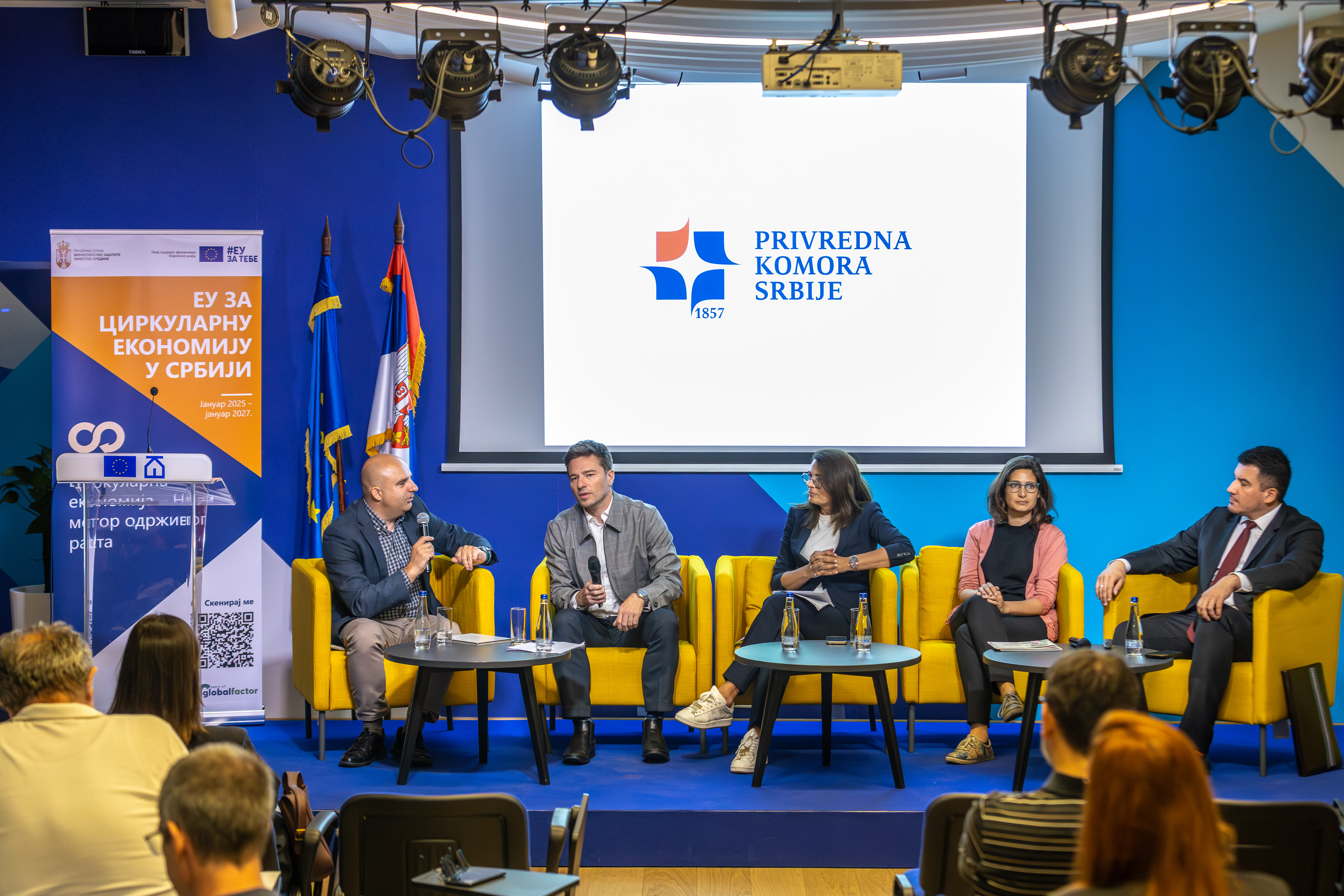
As part of the European Green Week, two panel discussions on the circular economy were held at Europe House in Belgrade, organized within the framework of the project “EU for the Circular Economy in Serbia.”
Representatives of five Serbian companies, along with the Ministry of Environmental Protection, the Chamber of Commerce and Industry of Serbia, the Delegation of the European Union to Serbia, and the United Nations Development Programme (UNDP), discussed how the circular economy can enhance competitiveness, increase efficiency, and enable resource savings.
Reducing textile waste, saving water, and utilizing waste heat in food production are among the first measurable results achieved by the companies Jasmil, PS Fashion, Dax Intimo, Global Sistem Kooperativa, and Ribella Foods after introducing circular practices into their operations.
Ana Mitić-Radulović and Vladimir Jovanović from UNDP Serbia presented circular initiatives in the textile and agricultural sectors supported through the projects “Circular Communities in the Republic of Serbia” and “EU for the Green Agenda in Serbia.” To date, these initiatives have supported solutions aimed at improving textile and construction waste management, advancing digital agriculture, and strengthening sustainable women’s entrepreneurship.
The project “Reducing the Carbon Footprint of Local Communities through the Application of Circular Economy Principles in the Republic of Serbia – Circular Communities” is implemented by UNDP in partnership with the Ministry of Environmental Protection of the Republic of Serbia, with financial support from the Global Environment Facility (GEF).
The project “EU for the Green Agenda in Serbia” is implemented by UNDP, with the technical and financial support of the European Union, in partnership with the Ministry of Environmental Protection, and in cooperation with the Embassy of Sweden and the European Investment Bank (EIB), with additional funding provided by the governments of Sweden, Switzerland, and Serbia.