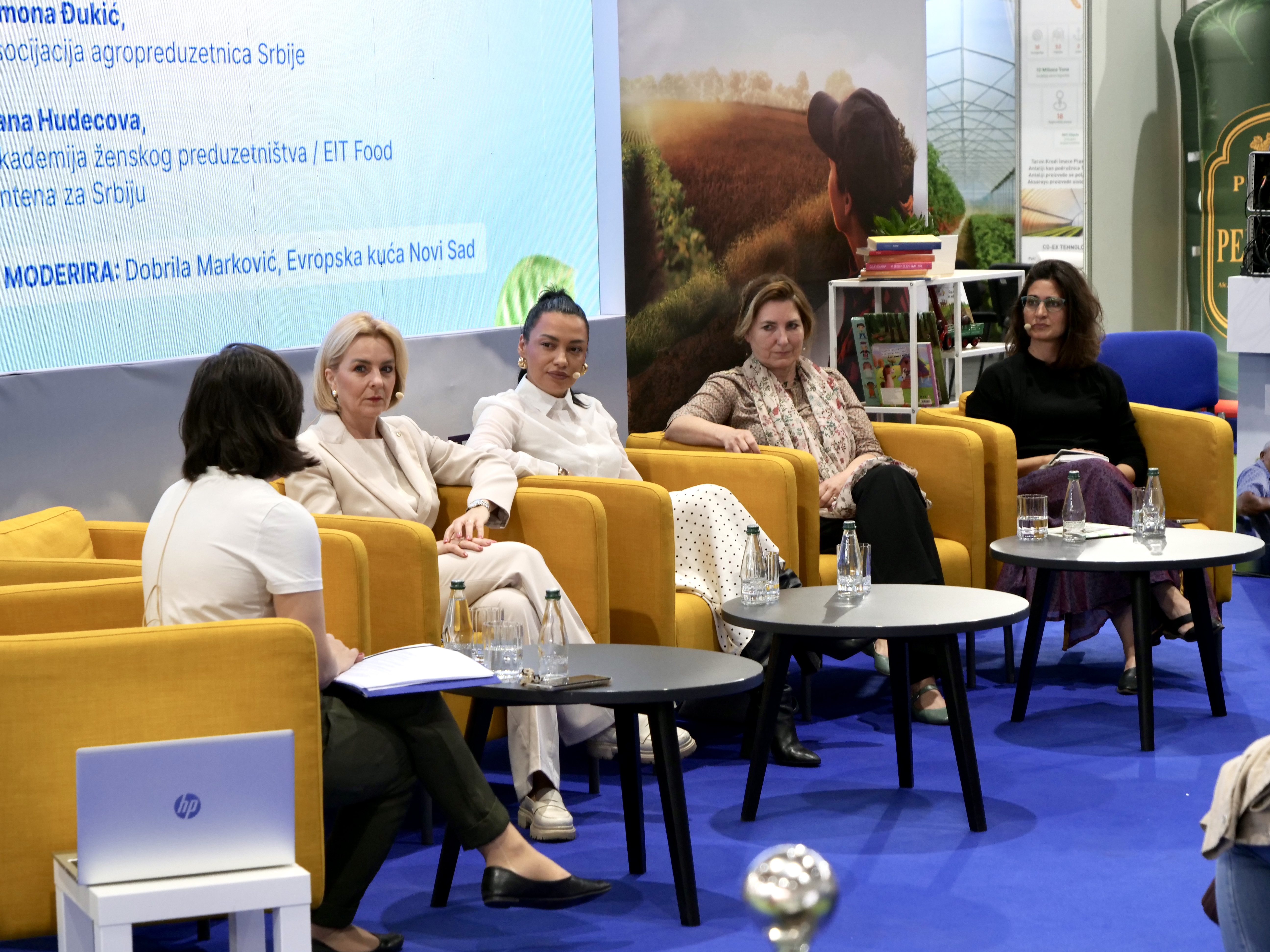
A panel discussion titled “Conversations That Matter” was held at the European Union Delegation Pavilion during the International Agricultural Fair in Novi Sad, focusing on the position of women in rural areas, the green transition, and innovations transforming the agricultural sector.
The discussion on women’s economic empowerment, the challenges they face, and examples of successful practices from Serbia and the region featured Dragana Tar of the Food and Agriculture Organization of the United Nations (FAO), Simona Đukić from the Association of Women Agripreneurs of Serbia, Jana Hudecová from the Women’s Entrepreneurship Academy / EIT Food Hub Serbia, and Ana Mitić-Radulović from the United Nations Development Programme (UNDP).
Panelists highlighted that women carry out a significant share of work in rural communities, yet their contributions often remain insufficiently visible and economically recognized. This issue has gained further attention with the observance of the International Year of Women Farmers. Despite these challenges, women are increasingly becoming drivers of sustainable solutions, circular products, and innovative businesses that are transforming local communities and creating new opportunities for rural development.
With the support of international donors and through various programmes, UNDP Serbia has supported the implementation of more than 80 circular innovations, with a total value of USD 2.5 million. In addition, through last year’s Public Call for Innovative Women Entrepreneurs—which included successful circular solutions in agriculture—more than USD 240,000 in support was awarded.
On this occasion, entrepreneur Jasna Mauković from Šid shared her experience as the recipient of an award for her circular initiative, “From Nature, for Nature – Sustainable Hazelnut Production through Women’s Innovation.” The project is implemented entirely by women, from production to promotion and sales, thereby strengthening their economic independence and role within the local community. Its business model is based on closing production loops, meaning that all waste generated during cultivation and processing is transformed into new cosmetic and food products. Plant biomass is used to produce humus, while by-products from oil extraction are processed into gluten-free protein flour.
The Public Call for Innovative Women Entrepreneurs was launched as part of the project “Reducing the Carbon Footprint of Local Communities through the Application of Circular Economy Principles in the Republic of Serbia – Circular Communities,” implemented by UNDP in partnership with the Ministry of Environmental Protection of the Republic of Serbia, with financial support from the Global Environment Facility (GEF).